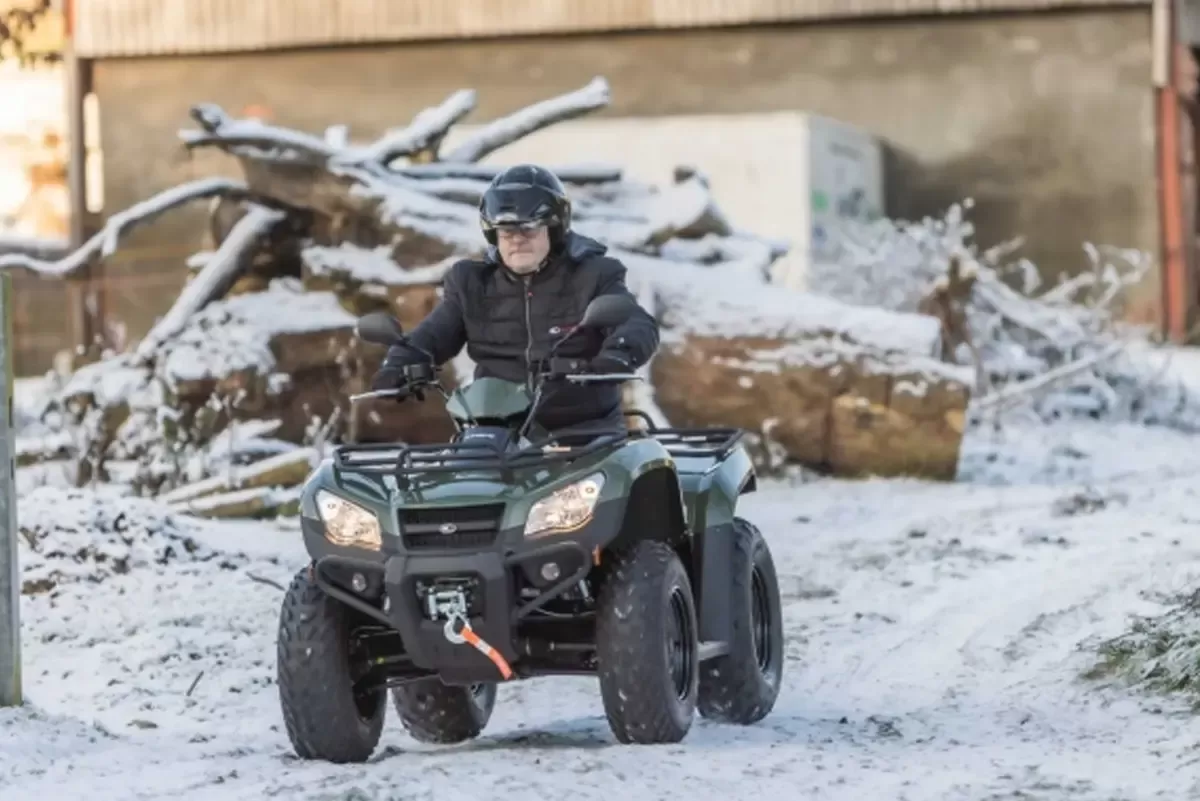
Kymco ATV Winter Preparation Guide: The Essential Checklist
POSTED: 14/09/2026
Autumn arrives quickly in Britain, and for Kymco ATV and UTV owners - whether you run a working farm, manage an estate, or use your machine for recreational riding - the weeks from September to November are the right time to carry out a thorough pre-winter check. A couple of hours in the shed now can prevent a costly breakdown in January when you need your machine most.
Why Winter Preparation Matters for UK ATV Owners
UK winters are not extreme by global standards, but they are consistently wet, frequently muddy, and capable of delivering genuine hard frosts - especially in Scotland, Wales, the Pennines, and the West Country. For a machine that spends most of its life in these conditions, the combination of standing moisture, freezing temperatures, and salt-laden air creates a specific set of wear patterns that a standard service schedule may not fully address.
The most common causes of winter ATV failures in the UK are not dramatic mechanical events - they are battery discharge in cold temperatures, seized brake calipers from standing mud, and fuel system issues in machines left partially filled for extended periods. All three are straightforward to prevent. The checks below cover every system you need to work through before the worst of the weather arrives.
This guide is written for the full Kymco ATV and UTV range - from the MXU 150 through to the UTV 700 - though specific guidance varies by model where relevant.
Engine and Fuel System - Getting Ready for Cold Starts
Coolant and Antifreeze
The MXU 300 T3B, MXU 465, MXU 550i EPS, MXU 700i ABS EPS, and UTV 700 are all liquid-cooled engines. Before winter, check that your coolant concentration is appropriate for the temperatures you are likely to face. Standard 50/50 antifreeze mix protects to approximately -34°C - well beyond any realistic UK scenario - but coolant degrades over time, and an old mix may have dropped its protection level. If your machine has not had a coolant change in two years, now is the right time.
The MXU 150 and Maxxer 90 are air-cooled and have no coolant system to check.
Fuel
Modern ethanol-blended petrol (E10 is now the UK standard fuel) is hygroscopic - it absorbs moisture from the air. A tank left partially full over winter is prone to moisture contamination, which can cause starting difficulties and, in severe cases, fuel system corrosion. Before winter storage (if applicable), either run the tank down as low as safely possible or fill it completely to minimise the air gap above the fuel.
For machines used year-round, this is less of a concern - regular use keeps fuel fresh. Run your machine at least once a fortnight through winter even if farm work is lighter than usual.
Air Filter
Wet autumn conditions push more debris through the intake than dry summer riding. Check and clean the air filter as part of your pre-winter service - a restricted air filter causes rich running, harder starting in cold temperatures, and increased fuel consumption. If the filter has significant hours on it, replace it rather than cleaning it.
Battery - The Most Common Cause of Winter Failures
Lead-acid batteries - the type fitted to most ATVs and UTVs - lose a significant proportion of their available capacity in cold temperatures. A battery that tests at 100% capacity at 20°C may deliver only 50–60% of that capacity at 0°C. If your battery was already showing signs of weakness before summer, it is almost certain to fail during the first hard frost of winter.
The practical checks are simple:
First, clean the battery terminals. Corrosion at the terminal connections increases resistance and reduces the current available for starting. Remove the terminals, clean them with a wire brush, and apply a thin coat of petroleum jelly to inhibit future corrosion.
Second, assess the battery's condition. If your machine has a battery management system or you have access to a basic battery tester, check the battery's state of charge and its cold cranking amps (CCA) rating against the specification. Any battery showing significant capacity loss should be replaced before winter rather than after a roadside failure in January.
Third, for machines used infrequently, invest in a quality battery maintenance charger - sometimes called a trickle charger or battery tender. These devices keep the battery at optimal charge without overcharging it, and they are one of the most cost-effective investments you can make in your machine's reliability.
"A battery that barely gets your machine started in September will not start it at all in February."
Brakes, Tyres, and Suspension - The Ground Contact Checks
Brake Pads and Discs
Mud and grit ingress into brake calipers is one of the most under-appreciated causes of ATV brake problems in the UK. Autumn farm work - particularly on clay soils - packs mud into caliper housings, where it can hold moisture against metal surfaces and cause corrosion that ultimately leads to seized pistons and uneven braking.
Clean the caliper housings thoroughly before winter. Check pad thickness on each wheel - the minimum serviceable thickness varies by model, so refer to your owner's manual. If pads are approaching the wear limit, replace them before winter rather than during it. Check the disc surfaces for deep scoring or cracking.
Tyre Pressure and Condition
Tyre pressure drops approximately one PSI for every 10°C fall in ambient temperature. A tyre set to the correct pressure on a 20°C September afternoon will be noticeably under-inflated on a -5°C January morning. Check tyre pressures at the start of each week through winter, or invest in a portable compressor to keep in the farm workshop.
Inspect tyre condition at the same time. Look for cracking in the sidewalls - a common issue in older tyres that have been exposed to UV and weathering - and check tread depth, particularly for machines that will be ridden on road-legal T3B registration across public roads between fields.
Suspension and Steering Components
Check all grease nipples and apply fresh grease to ball joints, tie rod ends, and pivot points. These components wear faster in wet, muddy conditions, and dried-out grease accelerates wear significantly. Pay particular attention to the front suspension components, which take the most punishment on rough terrain.
4WD, Differential Lock, and EPS - Winter-Specific System Checks
The MXU 465, MXU 550i EPS, MXU 700i EPS, and UTV 700 all feature selectable 4WD with a locking differential - the systems you will rely on most heavily through winter. Before conditions deteriorate, test both systems to confirm they engage and disengage cleanly.
Select 4WD on a patch of flat, open ground and confirm all four wheels are pulling. Engage diff-lock and confirm it is functioning correctly. A 4WD system that is sluggish to engage, makes unusual noises, or fails to deliver the expected traction improvement should be inspected by your authorised Kymco dealer before you need it in earnest.
For models with Electric Power Steering (MXU 550i EPS, MXU 700i ABS EPS, and UTV 700), confirm the EPS is operating correctly. EPS relies on sensors and an electric motor that can be affected by moisture ingress if seals are damaged. If steering feel has changed or you notice unusual resistance, have it checked.
Pre-Winter Inspection Checklist - Kymco ATVs and UTVs
-
Coolant concentration checked (liquid-cooled models: MXU 300 T3B and above)
-
Fuel tank filled or run down - prevent E10 moisture absorption
-
Air filter cleaned or replaced
-
Engine oil level checked and viscosity verified for cold temperatures
-
Battery terminals cleaned and battery condition tested
-
Battery maintenance charger fitted (stored or infrequently-used machines)
-
Brake caliper housings cleaned, pad thickness measured
-
Tyre pressure set and tyre sidewalls inspected for cracking
-
Grease nipples lubricated - ball joints, tie rods, pivot points
-
4WD and diff-lock tested and confirmed operational (applicable models)
-
EPS operation confirmed (MXU 550i, MXU 700i, UTV 700)
-
Body panels and frame inspected for stone chips - touch up before rust forms
-
All lights operational (particularly for machines used in early morning or short winter days)
-
Annual service booked if due - before winter, not during it
Body, Frame, and Undercarriage - Protecting Against Moisture
The underside of an ATV takes continuous punishment from stones, mud, and standing water. Before winter, clean the undercarriage thoroughly - a pressure washer is effective, but avoid directing high-pressure water directly at electrical connectors, brake caliper bleeder valves, or sealed bearing housings.
After washing, inspect the frame for any stone chips or scratches in the paintwork that have reached bare metal. Any exposed metal will begin to corrode over a wet winter. Touch up with a matching touch-up paint before moisture can penetrate. Check that all body panels are securely fitted and that any drain holes in footwells or rear cargo racks are clear.
Inspect wheel bearings by lifting each corner of the machine and spinning the wheel - any roughness, clicking, or significant play indicates a worn bearing that should be replaced before winter adds further stress to it. Checking bearings on a dry autumn day is significantly more straightforward than sourcing and fitting a replacement in a muddy yard in February.
Storage vs Year-Round Use - What Changes?
Not all Kymco ATV owners use their machines through winter. Recreational riders and some smallholders will put their machine away from November to March. Those with year-round farm operations will continue using theirs in all conditions. The maintenance approach differs accordingly.
If You Are Storing the Machine
A machine stored for more than 30 days should have its fuel system either drained or treated with a fuel stabiliser product to prevent gumming of the carburettor (on older non-FI models) or injector systems. Connect a battery maintenance charger. Apply a light protective spray to all exposed metal surfaces. Store indoors or under a breathable cover - a non-breathable cover traps condensation and accelerates corrosion.
Before returning the machine to use in spring, run through the same pre-season checklist: check all fluid levels, inspect tyre pressures, clean brake calipers, test lights, and confirm 4WD operation before taking the machine back into the field.
If You Are Using the Machine Year-Round
Year-round farm use through a British winter demands a higher frequency of basic maintenance than summer riding. Check tyre pressures weekly as temperatures fluctuate. Clean brake calipers and wheel hubs after any session in heavy mud before mud packs and dries. Check battery condition monthly. Book your annual service at the end of summer rather than waiting until spring - your Kymco dealer will be less busy in September and October than in March.
Kymco ATV and UTV Range - Key Winter Specifications (Prices Exc. VAT)
| Model | Engine | Drive | Diff-Lock | EPS | Best Winter Use | From |
|---|---|---|---|---|---|---|
| MXU 150 | 150cc air-cooled | 2WD | ✗ | ✗ | Light duties, firm ground | £3,249 |
| MXU 300 T3B | 300cc liquid-cooled FI | 2WD | ✗ | ✗ | Light farm tasks, road-legal | £4,299 |
| MXU 465 | 465cc liquid-cooled FI | 4WD | ✓ | ✗ | Mixed terrain, road-legal PLG | £5,349 |
| MXU 550i EPS | 550cc liquid-cooled FI | 4WD | ✓ | ✓ | Professional farm, heavy towing | £6,599 |
| MXU 700i ABS EPS | 695cc liquid-cooled FI | 4WD | ✓ | ✓ | Flagship, daily farm use | £8,249 |
| UTV 700 | 695cc liquid-cooled FI | 4WD | ✓ | ✓ | Two-up, 650kg tow, optional cab | £10,599 |
Winter Riding Tips for UK Conditions
Even a well-prepared machine requires adjusted riding behaviour in winter conditions. Ground that appears firm can conceal soft mud beneath a frost-hardened surface crust. Stopping distances on frozen ground are significantly longer than in summer conditions, even with ABS (fitted to the MXU 700i ABS EPS).
Engage 4WD before you need it rather than after you are already in difficulty. On models with a locking differential, use it proactively in soft ground rather than waiting until a wheel is spinning freely. EPS models will feel lighter to steer in cold conditions, but the underlying weight of the machine remains the same - do not let the reduced steering effort encourage overconfidence on steep, slippery slopes.
For T3B road-legal models used on public roads between fields - the MXU 300 T3B in particular - be aware that road surfaces are significantly more hazardous in icy or wet conditions. Reduce speed accordingly and increase following distances from other vehicles.
Dress appropriately. Cold air at ATV riding speeds accelerates heat loss dramatically. Wind chill at even modest speeds in sub-zero temperatures can cause rapid hypothermia. Waterproof, layered clothing and good gloves are operational necessities on a working farm, not optional extras.
Winter Prep - What You Gain vs What Skipping It Costs
✓ Do It Now
✗ Leave It Until Spring
When to Book a Service
The recommended service interval for Kymco ATVs is 12 months or a specified number of operating hours - whichever comes first. If your machine is due a service between now and March, book it in September or October rather than waiting. Authorised Kymco dealers are typically busier in spring when everyone discovers their machine did not survive the winter in the condition they expected.
A full annual service from your authorised Kymco dealer covers the mechanical checks above in detail, plus items that require specialist tools - valve clearances, differential oil changes, brake hydraulic fluid renewal, and fuel system inspection. It is not a substitute for the pre-winter checks described here; it complements them.
Parts availability for all Kymco ATV and UTV models is supported domestically from Bridgend, South Wales - so if a part is needed, it reaches your dealer quickly through the UK distribution network rather than waiting on international freight. That matters when a machine is out of action in the middle of lambing or harvest.
To find your nearest authorised Kymco ATV dealer, use the dealer finder on kymco.co.uk. To review the full ATV and UTV range - including current pricing - visit the ATV range page.
Book Your Pre-Winter Service
Find your nearest authorised Kymco dealer to arrange a pre-winter service or discuss any concerns about your machine before the cold weather arrives.
