Kymco DTX320: The Adventure Scooter That Changes the Game
POSTED: 14/04/2026

Kymco DTX 320 Review — The Adventure Scooter That Changes the Game
The adventure scooter is a category that barely existed five years ago. Now it sits at the most interesting corner of the two-wheeled market — practical enough for daily commuting, characterful enough to tempt weekend riders away from the motorway. The Kymco DTX 360 range was built specifically for this space, and it arrives at a price that should make the established European brands take notice.
What Is the Kymco DTX 320?
The DTX 360 range is Kymco's crossover answer to the question: what if a maxi scooter looked like it meant business? Launched in 2021 and built to Euro 5 standards, the range comprises two models — the DTX 125, designed for CBT and A1 licence riders, and the DTX 320, the full 320cc variant reviewed here. It is the DTX 320 that makes most sense for UK adults, offering genuine motorway capability and the kind of everyday versatility that earns a permanent place in your garage.
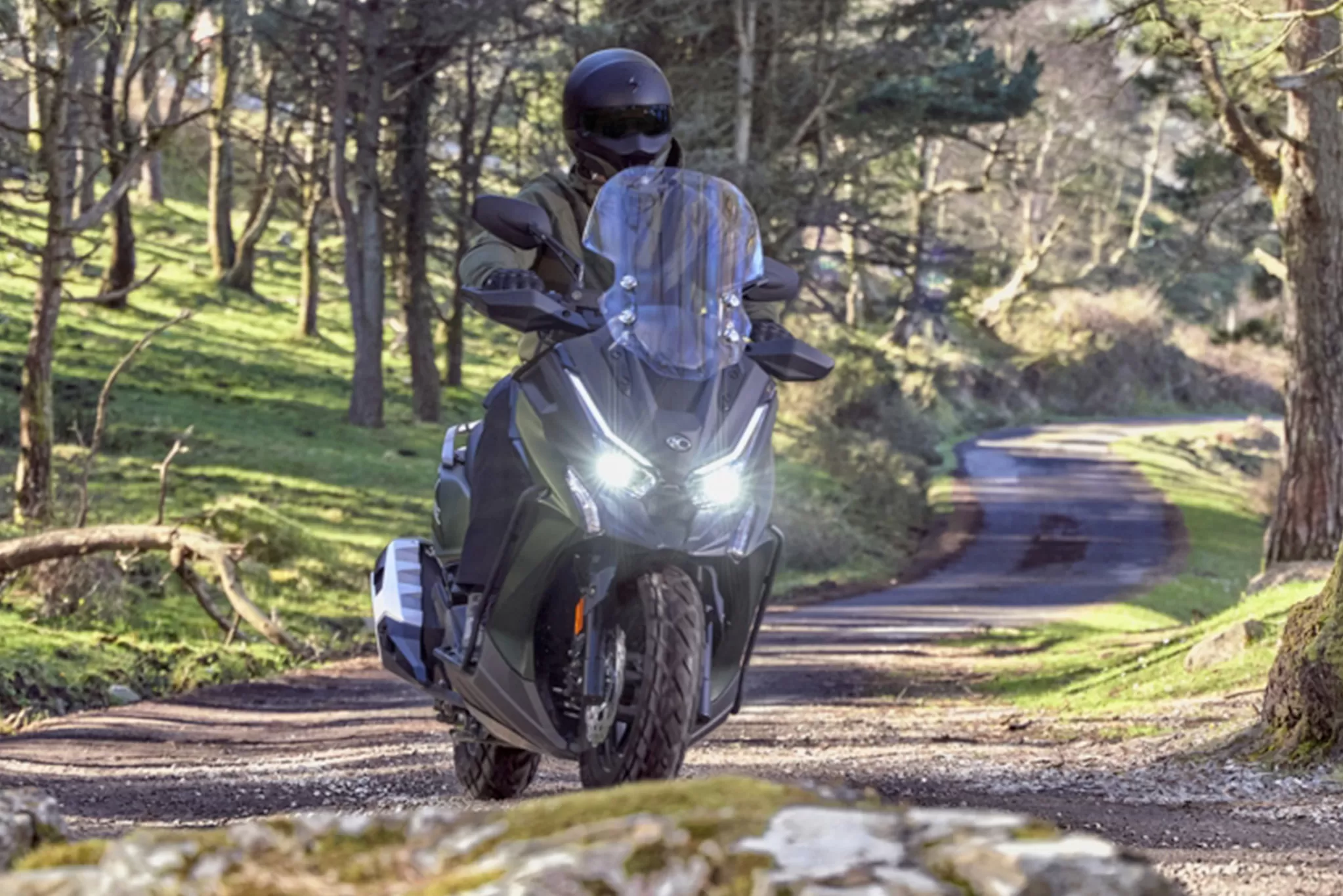
Visually, the DTX 320 makes a strong statement. Wide handlebars, pronounced knuckle guards, a high-riding stance, and adventure-spec semi-knobbly tyres give it a look that stands well apart from conventional maxi scooters in its price bracket. Whether you think it looks purposeful or theatrical probably depends on your taste — but it is certainly distinctive on UK roads.
The DTX 320 produces 21 kW, placing it comfortably within A2 licence restrictions without any power restriction kit required. That matters for riders who passed their test in the last decade and haven't yet progressed to a full A licence.
Engine & Performance: How Does It Ride?
At the heart of the DTX 320 is a 320.6cc liquid-cooled SOHC single-cylinder engine producing 28.2 bhp (21 kW) at 7,500 rpm and 30 Nm of torque at 5,750 rpm. Power is delivered through a CVT transmission — no clutch, no gearbox, just twist and go. For riders moving up from a 125, the difference in real-world punch is immediately apparent.
On UK roads, the DTX 320 handles itself well. Urban riding is effortless — the engine pulls cleanly from low revs, and filtering through traffic feels natural thanks to the wide handlebar leverage that gives you precise low-speed control. Once out of town, cruising at national speed limit requires no strain from the engine, and overtaking at 60–70 mph is dealt with confidently. The quoted top speed sits around 85 mph, which is sensible rather than spectacular, but more than adequate for UK conditions.
What impresses most is the smoothness of the CVT delivery. There are no surges or flat spots across the rev range, and the engine note settles into a quiet, composed hum once above 50 mph. For riders who commute through a mix of city traffic and A-roads, the DTX 320 rarely asks you to work hard.
"On UK roads, the DTX 320 handles itself well. Urban riding is effortless — the engine pulls cleanly from low revs, and filtering through traffic feels natural."
Off-Road Capability: How Much Adventure Can It Actually Handle?
Let us be direct here, because adventure styling and adventure capability are not the same thing. The DTX 320 is built to handle UK country roads, green lanes, and compacted gravel tracks rather than technical off-road terrain. If you are expecting enduro performance from a 194 kg scooter with a CVT, you will be disappointed. If you want a machine that handles potholed B-roads, wet leaves, and the occasional gravel track without drama, the DTX 320 does that convincingly.
The semi-knobbly tyres — 120/80-14 front and 150/70-13 rear — provide genuinely better wet grip than standard road tyres, which is more relevant in the UK climate than any off-road posturing. The telescopic front forks with 110 mm of travel and the five-way adjustable rear units soak up poor surfaces with more composure than you would expect at this price point. Ground clearance is usefully generous, and the upright riding position keeps weight balanced and planted.
Traction control (TCS) is standard equipment, which further builds confidence on loose or slippery surfaces. It is unobtrusive and does not sanitise the riding experience — it simply catches slides before they become problems. In a British autumn or winter, that matters.

Wide handlebars, knuckle guards and adventure tyres — the DTX 320 looks purposeful and backs it up on real UK roads.
Comfort & Ergonomics: Built for Real-World UK Roads
The DTX 320's seat height of 800 mm sits at the sportier end for a scooter, but the ergonomics are genuinely comfortable for sustained riding. The wide handlebars place your wrists in a natural position, the footboards are well positioned for a range of rider heights, and the seat offers good support across longer journeys.
The adjustable windscreen provides reasonable protection at motorway speeds — not exceptional, but enough that you will not arrive at your destination exhausted from fighting wind blast. Tall riders may find they want to upgrade to an aftermarket screen for extended touring. That is a fair compromise at this price.
At 194 kg dry weight, the DTX 320 is not a lightweight machine, but it carries its mass well. At low speed and when manoeuvring in car parks, it feels manageable. Once rolling, the weight becomes invisible. The 12.5-litre fuel tank and a real-world fuel economy of around 65 mpg translate to approximately 180 miles of range between stops — comfortable for most UK riding without range anxiety.
Tech & Features: What Do You Get for the Money?
The standard equipment list is one of the DTX 320's genuine strengths. At £4,799, you receive a full-colour TFT instrument display, keyless ignition, ABS brakes, traction control, all-LED lighting, and two USB charging ports as standard. These are features that cost more to add to several rival machines at the same price point.
The digital display is clear in both bright sunlight and low light, showing speed, fuel level, trip data, and a gear position indicator. Two USB ports are a straightforward practical touch for riders who rely on phone navigation.
Under-seat storage is functional rather than generous — there is room for a compact helmet or essentials, but the DTX 320 is not a long-distance tourer in the mould of the X-Town. The trade-off for the adventure styling is that storage space takes second place.
Kymco DTX 320 — Full Specification
| Engine | 320.6cc liquid-cooled SOHC 4-valve single-cylinder, Euro 5 |
| Bore × Stroke | 75.3 mm × 72 mm |
| Max. Power | 21 kW (28.2 bhp) @ 7,500 rpm |
| Max. Torque | 30 Nm @ 5,750 rpm |
| Transmission | CVT (stepless automatic) |
| Fuel Tank | 12.5 litres |
| Fuel Economy | Approx. 65 mpg |
| Range | Approx. 180 miles |
| Dry Weight | 194 kg |
| Seat Height | 800 mm |
| Wheelbase | 1,550 mm |
| Overall Length | 2,165 mm |
| Overall Width | 780 mm |
| Front Suspension | Telescopic forks, 110 mm travel |
| Rear Suspension | Double swing arm, 5-position adjustable, 100 mm travel |
| Front Tyre | 120/80-14 |
| Rear Tyre | 150/70-13 |
| Front Brake | 280 mm wavy disc, 3-piston caliper, ABS |
| Rear Brake | 260 mm disc, single-piston caliper, ABS |
| Colours | Khaki Green, Black/Orange |
| UK OTR Price | £4,799 |
Who Is the DTX 320 Best Suited To?
The DTX 320 has a specific ideal rider in mind, and it is worth being honest about who that is. This machine makes most sense for commuters and leisure riders who want something with more character and visual presence than a conventional maxi scooter, without paying flagship prices. It suits riders who cover a mix of urban traffic, A-roads, and the occasional rough lane, and who value practicality alongside personality.
A2 licence holders will find it particularly appealing — it is one of very few properly equipped adventure-styled scooters available within A2 power limits without restriction kits. For riders who passed their test within the last ten years and ride on an A2 licence, the choice in this segment is genuinely limited. The DTX 320 gives them something interesting to ride.
It is less well-suited to committed touring riders who need extensive storage, or to those expecting genuine off-road capability. If you want luggage capacity and long-distance comfort above all else, the Kymco AK 575 Premium is a more appropriate tool. If you are a new rider on a 125cc scooter looking ahead to your first upgrade, the DTX 320 is a natural next step — genuinely better in almost every respect, but without the intimidating step up in size and weight that a traditional motorcycle represents.
Pricing & Value: Is It Worth It?
At £4,799 OTR, the DTX 320 positions itself very compellingly against its nearest rivals. The Honda ADV350 — the machine Kymco most clearly had in mind when developing the DTX — is priced at approximately £5,899, a saving of over £1,100. The Suzuki Burgman 400 sits higher still. The Yamaha XMAX 300 competes more closely on price but offers a notably different character — more conventional maxi scooter, less adventure styling.
When you weigh the standard equipment list against those prices, the Kymco case becomes straightforward. You receive traction control, ABS, a TFT display, keyless ignition, and USB charging as standard, in a machine that undercuts the Honda ADV350 by over £1,100. The Yamaha XMAX 300 — often cited as the closest rival — offers no traction control as standard at this price point.
Running costs are competitive. At 65 mpg, even with current fuel prices, daily running remains modest. Insurance groups for the DTX 320 are broadly similar to competitors in the 300–400cc class, and parts availability from Kymco's UK network is improving as the model matures.

The DTX 320 in Khaki Green — a distinctive alternative to the conventional maxi scooter in its price bracket.
Verdict
The Kymco DTX 320 is a machine that does what it says with conviction, provided you understand what it is saying. It is not an off-road tool. It is not the most storage-efficient commuter in its class. What it is, emphatically, is an engaging, well-equipped, and attractively priced scooter with genuine character that earns its adventure styling rather than merely borrowing it from a marketing department.
For A2 licence holders, for commuters who want something interesting to ride, and for riders upgrading from 125cc machines, the DTX 320 makes a convincing argument. At this price, with this specification, and against this competition, Kymco has produced something that deserves to be taken seriously.
What Works Well
- ✓ Excellent standard equipment at this price
- ✓ A2 licence eligible without restriction
- ✓ Comfortable on UK roads and B-roads
- ✓ Over £1,100 cheaper than Honda ADV350
- ✓ Strong real-world fuel economy (~65 mpg)
- ✓ Distinctive, purposeful styling
Honest Considerations
- ✗ Limited under-seat storage vs conventional maxi scooters
- ✗ Off-road capability is light trail only — not enduro
- ✗ 800 mm seat height may challenge shorter riders
- ✗ 194 kg weight takes getting used to at low speed
- ✗ Kymco dealer network smaller than Japanese rivals
Ready to See the DTX 320 in Person?
View the full specification and colour options online, or speak to your nearest Kymco dealer to arrange a test ride.
View the Kymco DTX 320 Find a Dealer Near You
